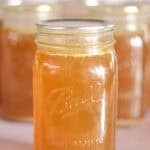
How to Pressure Can Bone Broth
Learn how to pressure can bone broth safely with this beginner-friendly, step-by-step guide. Includes PSI, processing times, storage tips, and essential safety guidance.
Equipment
- 1 Pressure Canner
- 1 funnel
- 1 Jar Lifter
- Clean Jars
- Rings
- Lids
Ingredients
- Bone Broth
Instructions
- Inspect and wash jars. Check 6 quart jars for nicks or cracks, then wash jars, lids, and rings in hot soapy water.
- Keep jars hot (boiling-water method). Place clean jars upright in a large pot or canner, cover with water, and keep at a gentle simmer until ready to fill. Hot jars prevent breakage when filled with hot broth.
- Chill and defat the broth (recommended). Cool broth in the refrigerator and skim off excess fat. Removing fat helps ensure a good seal and improves storage quality.
- Reheat broth to a boil. Bring broth to a full boil before filling jars so everything stays hot during the canning process.
- Fill hot jars. Lift one hot jar from the water, drain, and place on a towel. Using a funnel, fill with boiling broth, leaving 1 inch headspace.
- Clean rims. Adjust headspace if needed, then wipe the rim with a vinegar soaked cloth, then wipe rims with a clean, dry cloth.
- Apply lids and rings. Center the lid and screw the band on until fingertip-tight (snug but not forced).
- Prepare the canner and load jars. Place the rack in the pressure canner and add the amount of water specified in your manual (often 2–3 inches). Heat until hot but not boiling, then place filled jars onto the rack using a jar lifter and lock the lid.
- Vent, pressurize, and process. Heat until a steady column of steam escapes and vent for 10 minutes. Add the weight or close the vent to bring the canner to the correct pressure for your altitude, then process pint jars for 20 minutes or quart jars for 25 minutes at 10-11 PSI, maintaining steady pressure the entire time. (see notes on PSI for various altitudes)
- Cool the canner and jars gradually. Turn off heat and allow pressure to return to zero naturally. Wait 5 minutes, remove the lid away from your face, and let jars rest in the open canner for 10 minutes before moving them. Transfer jars to a towel-lined surface and cool undisturbed for 12–24 hours.
- Check seals and store. Remove rings, check that lids are sealed, wipe jars clean, label, and store in a cool, dark place. Refrigerate any unsealed jars and use promptly.
Notes
- Use pressure canning for safety. Bone broth is a low-acid food and must be pressure-canned to reach temperatures that destroy harmful bacteria.
- Remove excess fat before canning. Chilling and skimming the broth helps ensure proper sealing and prevents rancid flavors during storage.
- Hot broth + hot jars = best results. Filling hot jars with boiling broth reduces thermal shock and helps prevent liquid loss.
- Leave 1 inch headspace. Proper headspace allows for expansion during processing and supports a strong seal.
- Maintain steady pressure. Fluctuating pressure can cause siphoning (liquid loss) and may affect seal quality.
- Altitude affects PSI requirements. Always adjust pressure based on elevation:
- Dial-Gauge Canner
- 0–2,000 ft: 11 PSI
- 2,001–4,000 ft: 12 PSI
- 4,001–6,000 ft: 13 PSI
- 6,001–8,000 ft: 14 PSI
- Weighted-Gauge Canner
- 0–1,000 ft: 10 PSI
- Above 1,000 ft: 15 PSI
- Processing time:
- Pints: 20 minutes
- Quarts: 25 minutes
- Let the canner cool naturally. Forcing pressure down can cause siphoning and seal failures.
- A small amount of liquid loss is normal. As long as jars seal properly, the broth is safe to store.
- Store without rings. Removing bands prevents trapped moisture and makes seal failures easier to detect.
- For best quality, use within 12–18 months.
